Follow-up Testing
Flexible follow-up testing
MyOme offers flexible options to support continued and family-based genetic testing.
Re-requisition services are available for those who have previously completed testing and would like to pursue additional analysis, either by reanalyzing existing data or initiating a new test with a new sample.
Family variant testing is also offered to determine whether relatives may carry a known genetic finding identified in a family member, which may help guide medical care.



Streamlined re-requisitions
At MyOme, we believe genomic insights should evolve alongside clinical needs. Our whole-genome backbone enables easy re-requisitions- no new sample, no hassle- whether for updated tests, changes in eligibility, or new clinical information
Common reasons for re-requisition of previous testing:
- A newly launched diagnostic or proactive test is now available and can be ordered using the original whole-genome data.
- Updated clinical information may affect test selection or result interpretation.
- The patient becomes eligible for testing due to revised program or insurance criteria.
- Additional or expanded analysis is needed as more genes or variants gain clinical relevance.
If you’re unsure whether a re-requisition is appropriate or need support, we’re here to help.
- Log in to the MyOme Provider Portal
- Locate the original patient order or start a new one
- Select "Re-requisition" and follow the on-screen instructions
- Resubmit updated information or consent forms, if needed
If you’re unsure whether a re-requisition is appropriate or need support, we’re here to help.
Family Variant Testing: Follow-up testing for relatives
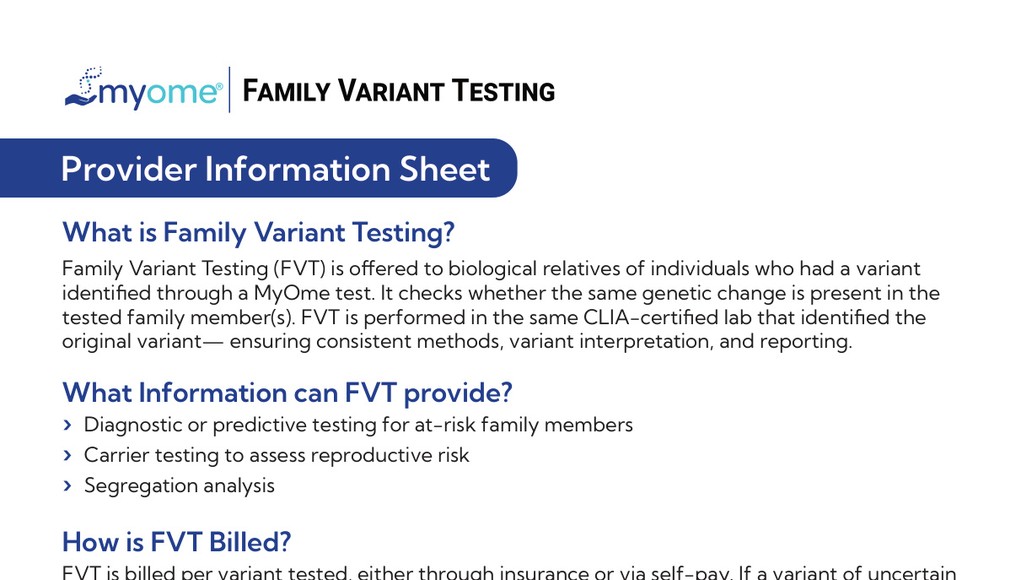
Family Variant Testing (FVT) is available for biological relatives of individuals with a genetic variant identified through a MyOme test. FVT determines whether the same genetic change is present in the family member being tested.
This targeted test can provide important diagnostic, predictive, or reproductive risk information, often helping clarify risk within families or resolve uncertain results.
- Diagnostic or predictive testing for at-risk biological relatives
- Carrier testing to assess reproductive risk
- Segregation analysis to help clarify uncertain findings
The MyOme order number (RQ number) and date of birth of the original tested individual (proband) are required to initiate testing. This ensures we test for the correct variant and maintain consistency in lab methods and interpretation.
To complete the FVT order, you must include:
- Proband’s RQ number (from their MyOme test)
- Patient’s Date of Birth
- Clinical indication (e.g., asymptomatic or similarly-affected family member))
- Signed informed consent for genetic testing
If the original variant was a variant of uncertain significance (VUS), you may contact us to determine if the family member qualifies for no-cost testing as part of variant resolution.
- Log in to the MyOme Provider Portal
- Select “Family Variant Testing”
- Enter the RQ number and date of birth of the original tested family member (proband)
- Complete the online requisition form
Need help? Contact us at support@myome.com
Family Variant Testing is billed per variant tested. Patients may use insurance or pay out-of-pocket.
FVT results are typically delivered in 2–3 weeks.
Order a Follow-Up test
We make it easy to order follow-up testing. Talk to your healthcare provider to learn more.