

Increase prescribing efficiency
Start with the drug and dose the patient's genotype supports, rather than titrating toward it.

Medication Response™ analyzes how a patient's genetics affect their response to medication by uncovering pharmacogenomic (PGx) variants and alleles, helping providers optimize treatment, reduce adverse reactions, and improve outcomes.
medications covered
PGx variants and alleles analyzed
turnaround time from samples received
sample types accepted
Medication Response analyzes how a patient's genetics affect their response to medication by uncovering pharmacogenomic (PGx) variants and alleles, helping providers optimize treatment, reduce adverse reactions, and improve outcomes. Results pair each covered drug with the clinical guideline that applies to that patient's metabolizer status.
Because it runs on the genome, the same sample can be re-queried when a new prescription comes up — no repeat draw, no repeat wait.
Start with the drug and dose the patient's genotype supports, rather than titrating toward it.
One result informs every future prescription among the covered medications, for the life of the patient.

Identify poor and ultrarapid metabolizers before a first dose rather than after a reaction.
medications covered across these areas
When ordering, providers select the test type (Atlas Plus or Atlas Select), then choose the Medication Response test available under that type.
Uses 30X whole-genome sequencing to analyze variants in 15 pharmacogenes.
The Medication Response test option offered under Atlas Plus.
See what medications and conditions are includedUses blended high-coverage exome and low-coverage genome sequencing to analyze variants in 15 pharmacogenes.
The Medication Response test option offered under Atlas Select.
See what medications and conditions are includedEach report includes 15 pharmacogenes, with findings presented alongside relevant published clinical guidelines to give providers pharmacogenomic context at the point of care.
A Clinical Guidelines Supplement accompanies every report, summarizing published drug-gene guidance specific to the patient's results to aid interpretation and clinical action.
MyOme offers genetic counseling for a more comprehensive assessment and personalized medication management.
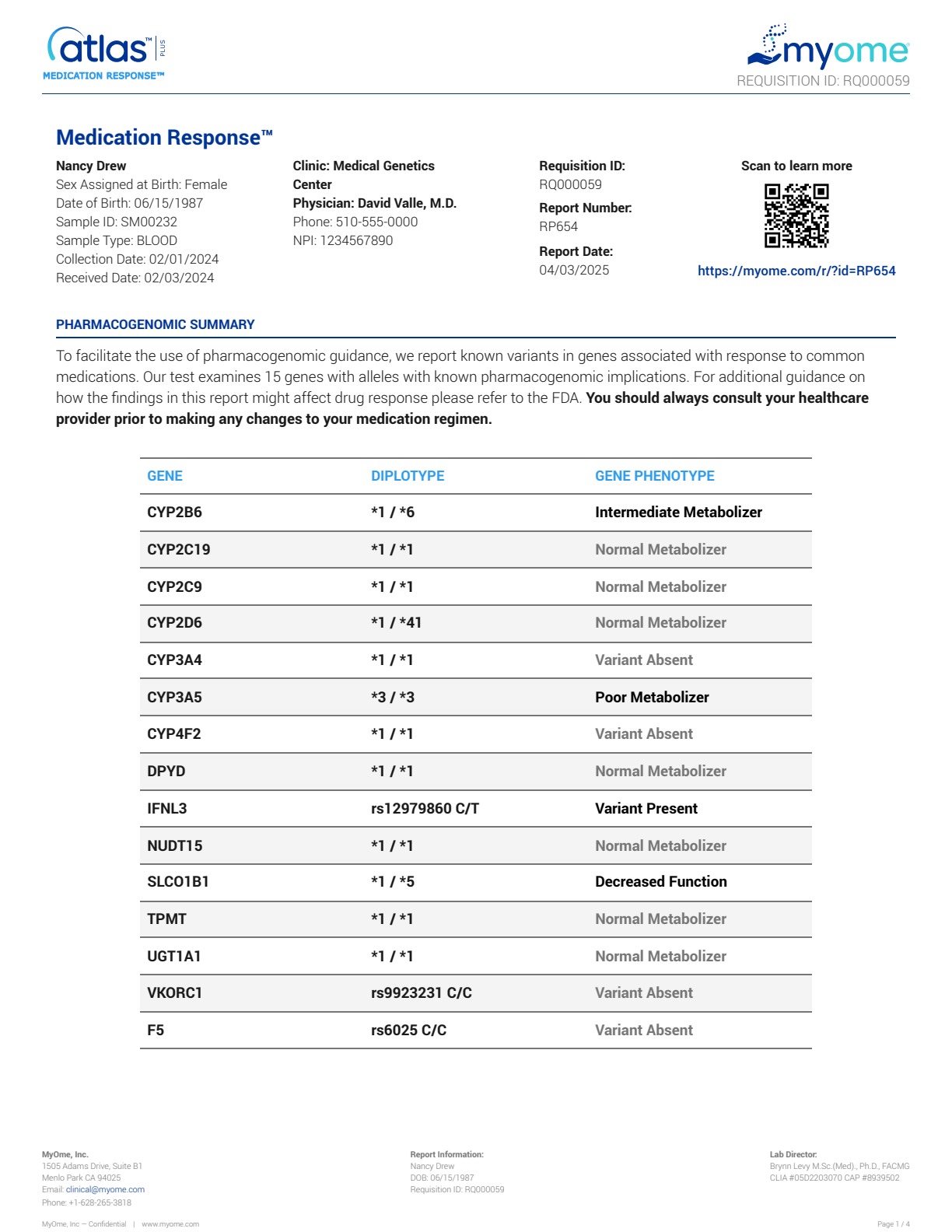
Representative report page — not an actual patient result.
Patients who are considering treatment for one of the covered conditions, or who want to take a proactive approach to guide potential medication choices in the future — helping to inform safer, more effective drug selection and dosing decisions.
From samples received, most results are delivered in 5 to 6 weeks. Follow-up testing or re-requisitions for existing MyOme patients are typically completed in under 2 weeks, often within a few days.
Turnaround times are estimates and begin once samples are processed at MyOme. They may be extended in cases outside MyOme's control, including delays related to confirmation testing or other unforeseen circumstances.
Current medications, age, weight, kidney and liver function, and diet all influence response to treatment.
Genes and variants outside the panel can affect drug metabolism and are not reflected in the result.
Results should be interpreted in the context of the patient's complete medical profile by a clinician.

We're here at every step — from ordering and sample collection to interpreting results with your patients.