~60%
Broad eligible population
Approximately 60% of prostate cancer risk is attributable to heritable factors, many of which can be detected as genetic markers by this test.¹

Combines genetic risk factors identified from whole-genome sequencing with clinical information to predict a person's 10-year and/or remaining lifetime absolute risk of developing prostate cancer.
Broad eligible population
Approximately 60% of prostate cancer risk is attributable to heritable factors, many of which can be detected as genetic markers by this test.¹
Beyond single-gene screening
Up to 95% of individuals do not have a single-gene prostate cancer condition, but may have genetic risk factors detectable by this test.²
Hidden risk detection
Our studies showed 8.6% of men* with no family history of prostate cancer were identified as high risk, with roughly 3× higher prostate cancer incidence compared to the non-risk group.³
1. National Cancer Institute. Genetics of Prostate Cancer — Health Professional Version. Accessed Nov 2025. 2. Tuffaha H, Edmunds K, Fairbairn D, et al. Guidelines for genetic testing in prostate cancer: a scoping review. Prostate Cancer Prostatic Dis. 2024;27:594–603. 3. Internal data on file. *MyOme recognizes and respects the diversity of gender identities. For the purposes of this webpage, "men" is used to refer to individuals assigned male at birth.
Individuals aged 30–75 with no personal history of prostate cancer and no pathogenic variant in ATM, BRCA1, BRCA2, CHEK2, HOXB13, MSH2, MLH1, MSH6, PALB2, PMS2, or TP53. For individuals under 40 or over 70, the test reports remaining lifetime risk only.
From samples received, most results are delivered in 5 to 6 weeks. Follow-up testing or re-requisitions for existing MyOme patients are typically completed in under 2 weeks, often within a few days.
Turnaround times are estimates and begin once samples are processed at MyOme. They may be extended in cases outside MyOme's control, including delays related to confirmation testing or other unforeseen circumstances.
When ordering this test, providers select the test type (Atlas Cancer Plus or Atlas Cancer Select), then choose Prostate Cancer Integrated Risk™.
Uses 30X whole-genome sequencing.
Uses blended high-coverage exome and low-coverage genome sequencing.
Increased risk results can inform proactive recommendations aligned with clinical guidelines, such as healthy lifestyle habits, earlier PSA and digital rectal exam screening.
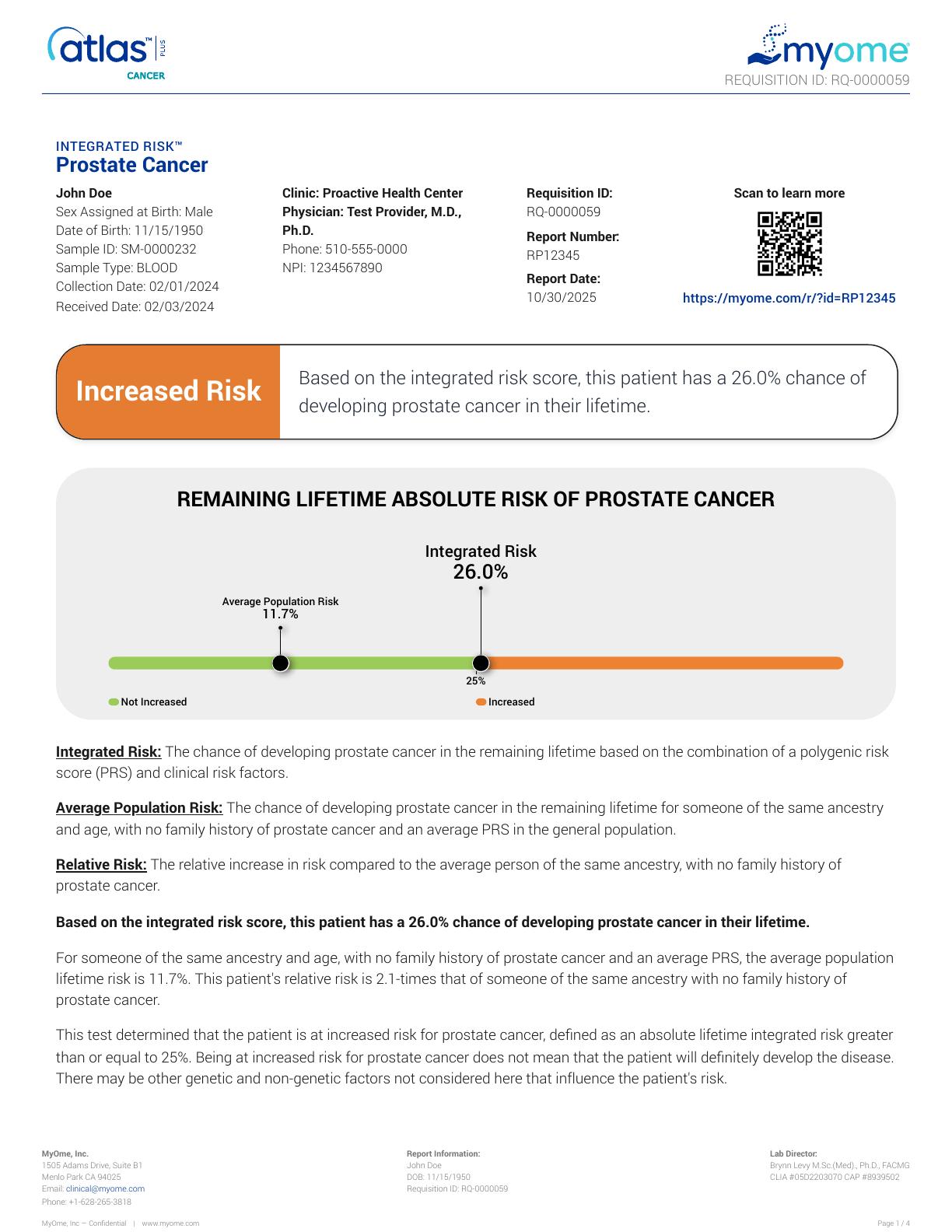
Representative report page — not an actual patient result.
This test is a screening tool, not a diagnostic test.
This test does not detect high-risk variants linked to monogenic conditions.
The Integrated Risk test is intended as a screening tool — some people with a high risk score will not develop prostate cancer and some with a low risk score will.
We're here at every step — from ordering and sample collection to interpreting results with your patients.